Video production portfolio: how to build one that attracts the right clients
A video production portfolio attracts the right clients when it works as a filter, not a gallery. Choose the client you want, show only work that proves you solve their problem, frame each project as a case study, and give a qualified viewer a direct path from that case study to a proposal.


Strategy
Decide which clients your portfolio should attract
The best way to create a video portfolio that attracts the right clients is to build it for a single client type and the problem they hire video to solve. Pick that client first, then show only work that proves you solve their problem, and cut everything that invites enquiries you would rather turn down.
Plenty of producers build a portfolio the way they would hang a group show: every good piece goes on the wall. A wedding film sits next to a product launch, a music video, a real estate walkthrough and a conference recap. The logic feels sound. More range should mean more work.
In practice, range tells a buyer very little. A marketing lead at a software company does not want to know that you can shoot anything. They want to know that you have solved their problem before, for a team like theirs, at a budget like theirs. When the page answers a different question, they either leave or send the message every producer dreads: "What do you charge?"
So change the job of the portfolio. Stop thinking of it as a gallery of your best work and start thinking of it as a filter. A gallery tries to impress everyone who lands on it. A filter is designed so that the right person leans in and the wrong person quietly moves on. Both outcomes are wins. The wrong client who never writes saves you a discovery call, a quote and a polite refusal.
Read the signals in your current enquiries
Before you rebuild anything, gather your recent enquiries, as many as you can find. They are the frankest review your portfolio will ever get, because each one is a reaction to what you chose to show. Patterns in those messages point straight at specific causes on the page.
Budgets vary widely across video buyers. Wistia's State of Video Report found that almost 40% of companies spent under $5,000 producing videos last year.
That is why client type matters before craft. A portfolio built for buyers with small video budgets attracts small briefs, however good the work. Decide whose budget you want to meet, then show the work that fits it.
Wrong-client signals and what usually causes them
Enquiries that ask only for a price
The portfolio shows clips but no thinking. With nothing to judge beyond the footage, the buyer compares you on the only thing left: the rate. Case studies with a brief, an approach and a result fix this.
Budgets well below your rate
The work on display looks like a different tier of project. If your homepage leads with low-stakes event recaps, buyers price you against event recaps, even if your best work is brand film.
Briefs outside your niche
Your categories are organised by format (weddings, corporate, music) rather than by client. Every format you list is an open invitation, so off-niche work keeps arriving in proportion to how much of it you show.
Buyers who want you to copy someone else
Your visual signature is hard to read. When every project uses a different look, the client cannot tell what you bring, so they send a reference reel and ask you to match it.
Long silences after a first call
The portfolio got the call but nothing in it helps the contact sell you internally. Decision-makers who were not on the call never see a story they can forward to their team.
Choose a single client type and a single problem
Now make the decision the old portfolio avoided. Name the client type you want more of over the coming years, and write down the problem they hire video to solve. Be concrete. "Corporate" is not a client type. "Marketing teams at B2B software companies who need launch films and customer stories" is. So is "independent hotels that need a brand film before reopening" or "architecture studios that want their buildings filmed for awards submissions".
The problem matters as much as the client. A software marketing team buys video to explain a product that is hard to see. A hotel buys it to make a place feel worth the trip. An architecture studio buys it to prove the quality of a space to a jury. Each problem rewards different projects, different pacing and a different kind of proof.
Treat your look as positioning
A niche tells buyers who you work for. A visual signature tells them why you, out of everyone else in that niche. The signature lives in specific choices: how you light faces, how you grade skin and product, which focal lengths you reach for, how fast you cut, whether you favour locked-off frames or a moving camera. Pick the choices that show up in your strongest work and let them repeat across the portfolio. Repetition is what makes a style recognisable. A viewer who sees the same considered look across several projects reads it as intent. A viewer who sees a different look in each reads it as whatever the client asked for.
Showreel
Build a showreel that earns the next click in its opening seconds
To create an attractive portfolio, start with the showreel: open on your strongest moment, keep it short, and cut it for a single niche rather than for everyone. Its job is not to close the deal. Its job is to earn the click into a full piece and a case study.
The showreel is the first thing buyers usually press play on, and often the last if it opens badly. Agency producers and in-house brand teams watch reels between meetings, usually with a shortlist open in other tabs. They are not looking for reasons to stay. They are looking for a reason to move on to the next name.
That changes how you cut. Title cards, slow fades from black, a logo animation and a long musical build all spend the precious opening seconds of the reel on nothing. Open on the frame that makes another filmmaker stop scrolling: your best shot, your boldest move, the moment a viewer would describe to a colleague. Think of the opening seconds as the whole reel for anyone who leaves early, and the rest as a reward for the people who stay.
Length follows the same logic. A long reel starts to repeat itself, and repetition reads as padding. Strong reels tend to be short. Shorter is fine when every shot earns its place. If you find yourself adding a shot because you like it rather than because it proves something to your target client, it belongs in a different cut.
Vidyard's Video in Business Benchmark Report found that if a video is under 1 minute long, 65% of viewers stay engaged all the way to the end.
Short holds attention. A reel is a business video like any other, and buyers watch it with the same impatience.
Wistia reports that videos under a minute average a 52% engagement rate.
Treat length as a craft decision, not a limit. Every second the reel runs has to earn the next one.
Rules for a reel that filters
Lead with your strongest opening
No title card, no fade in, no logo sting. Open on the shot that best shows your signature, then hold the pace through the first section.
Cut a separate reel per niche
A software launch reel and a hotel reel should share almost no footage. Make a separate reel for each client type you actively pursue and drop the generic catch-all cut.
Show story, not only shots
Include a few sequences that run long enough to show a beginning and an end. Buyers hire storytelling, and a montage of isolated beauty shots hides it.
Pair the reel with a complete piece
Place a full short film or campaign spot right under the reel. It proves you can sustain a narrative and gives a serious buyer something to forward.
End with a clear next step
Close the reel page with links into a few case studies for the same niche, so interest turns into reading rather than into a closed tab.

A final habit pays off here: watch your reel on a phone, with the sound off, before you publish it. Plenty of buyers see it exactly that way the first time. If the opening still lands as a small, silent rectangle, the reel is ready. If it only works on a calibrated monitor with headphones, rework the first section until it does not depend on either.
Selection
Choose and frame projects as case studies, not clips
What makes a good video editor portfolio is selection: projects that pass three checks (the client fits the type you want, the craft shows your signature, and there is evidence of what the work achieved), each framed as a short case study with the brief, your role, the constraint, your approach and the result.
The reel gets attention. Case studies get you hired. A clip on its own shows what you made. A case study shows how you think, which is what a buyer is really paying for when the brief is vague, the budget is fixed and the deadline is close.
Start with selection, because portfolios often fail here before a single word is written. Lay out every project you would consider showing and run each project through the same three questions. Would the client in this project recognise themselves in your target client? Does the work carry the look you want to be known for? Can you say what happened after it went out, even in a single plain sentence? A project that fails the first test goes, however good it looks. A project that passes every check goes near the top.
How many should survive? For a single niche, a small set is usually enough: enough projects to show depth, few enough that nothing dilutes it. A handful of case studies told well beat a long wall of clips with captions. If you are short on client work in your new niche, a well-made spec piece for an imagined client in that niche is more useful than another real project in the wrong niche, as long as you label it as spec.
NN/G surveyed 204 UX professionals in charge of hiring about what they look for in a portfolio.
Hiring managers in other fields read portfolios the same way video buyers do: they look for how you think, not just what you made. That is the job of a case study.
A case study structure buyers can skim
| Section | What to write | What it proves |
|---|---|---|
| The brief | Who the client was and what they needed video to do, in a couple of sentences | You understand the business problem, not only the shoot |
| Your role | Exactly what you did: direction, cinematography, edit, grade, or the full production | Honesty about credits, which buyers check |
| The constraint | The budget, timeline, location or access limit that shaped the work | You deliver under real conditions |
| The approach | The key creative decisions and why you made them | Your judgement, which is what they hire |
| The result | What happened after release, using only results the client shared or approved | The work did a job beyond looking good |
| Proof | A short client quote, the client logo with permission, and any festival or industry award | Someone else vouches for you |
Use proof you can stand behind
Testimonials, client logos and awards all carry weight, but only when they are real and specific. A single-line quote from the marketing lead who commissioned the film is worth more than a paragraph of generic praise. Ask for it within a few days of delivery, while the project is still fresh, and ask a direct question: what changed for them after the video went out? Their answer often gives you the result line for the case study too.
For work under NDA, describe the client by type ("a European fintech scaling into the US") and keep the case study focused on the brief and your approach, without footage. For work you only partly produced, state your exact role. Buyers who hire for direction will ask who directed, and a clear credit line protects you in that conversation.
Show the process, not only the polish
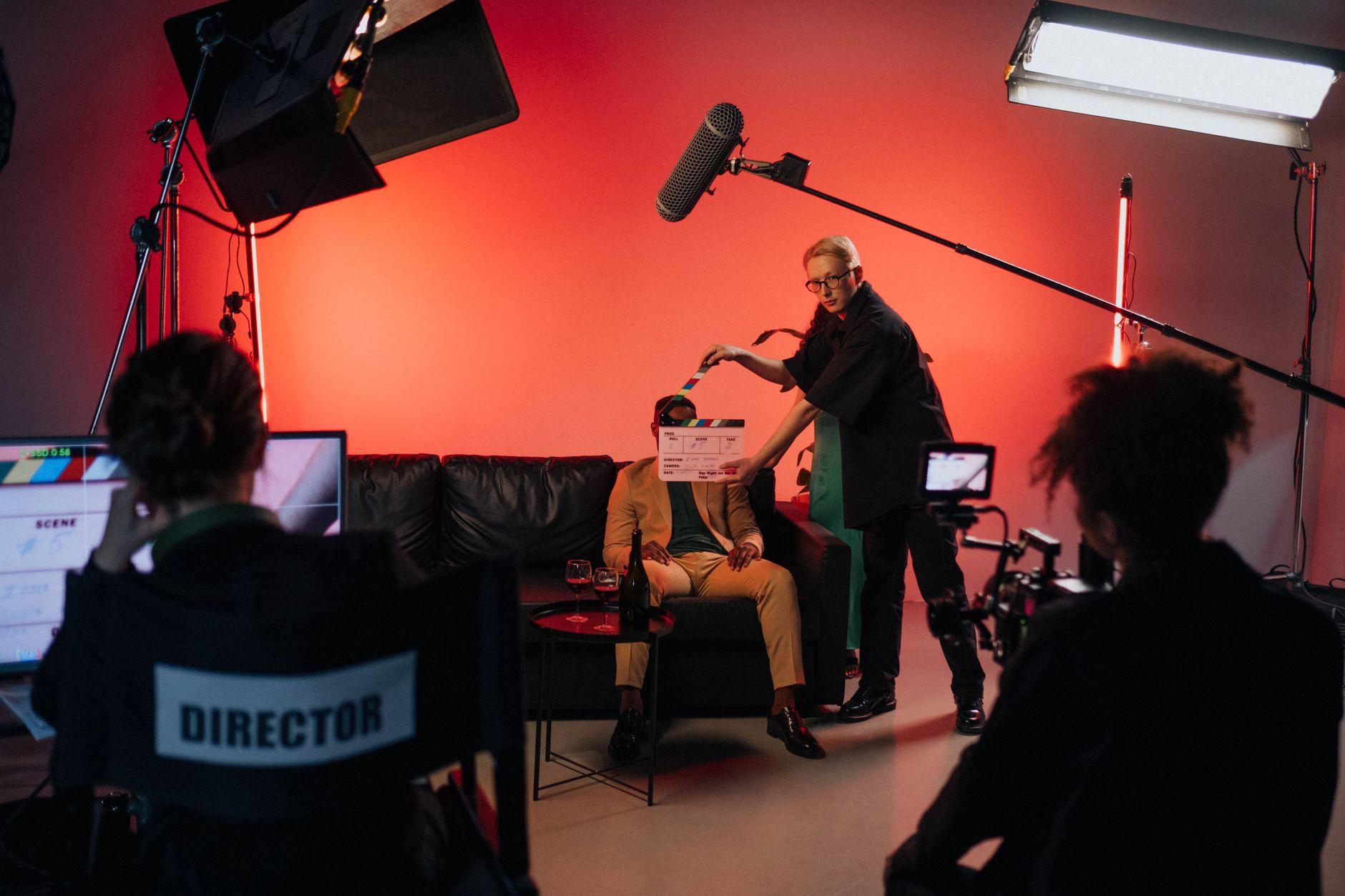
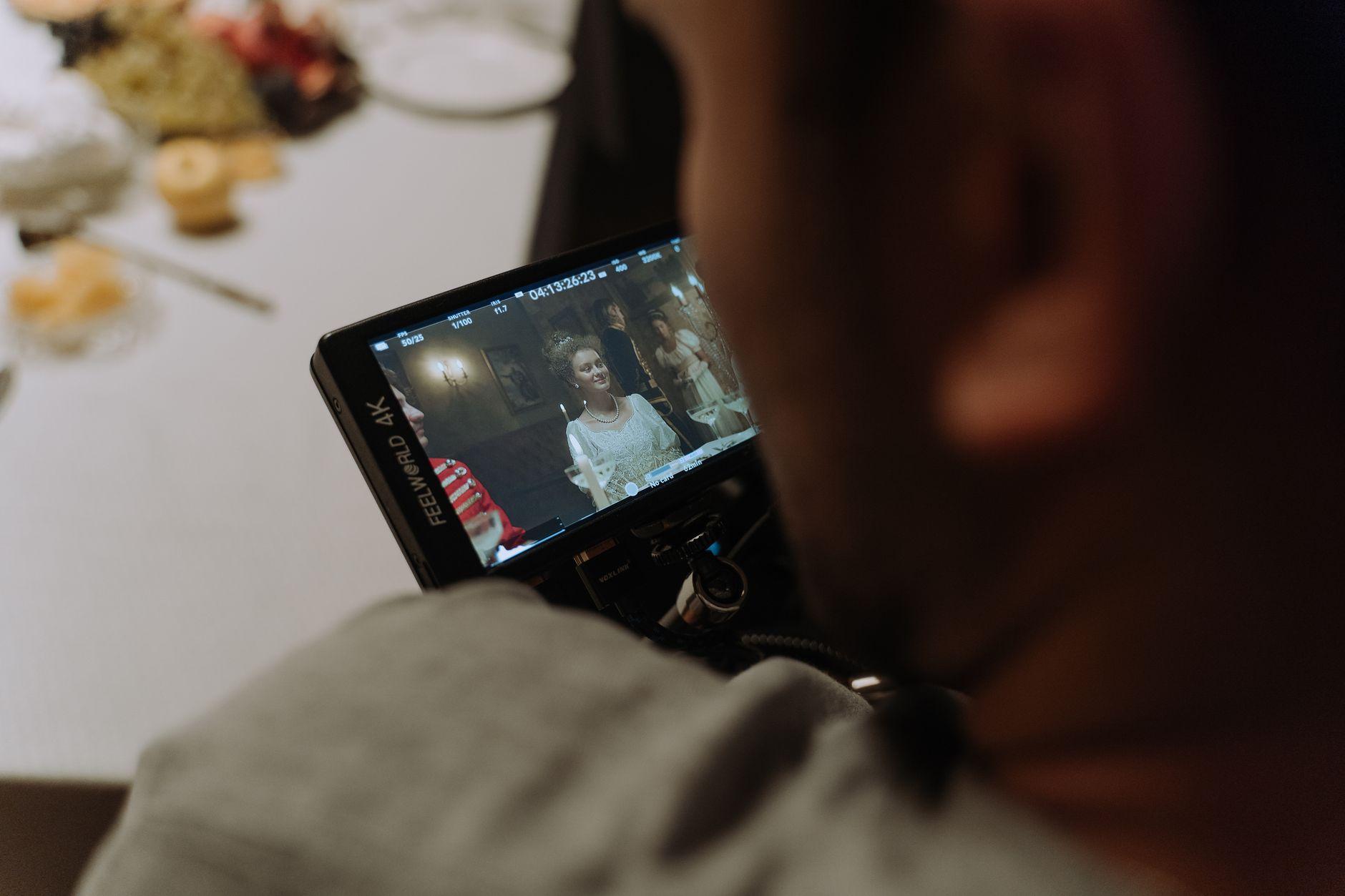
Behind-the-scenes material earns trust in a way finished footage cannot. A few stills of the lighting setup, the storyboard frame next to the final shot, or a short clip of the crew working through a tight location tells a buyer what it will feel like to have you on set. Keep it tight: a small gallery per case study is plenty.
Behind the scenes, in a few frames

Worked example
Rebuild a mixed portfolio for a single client type
Here is an illustrative rebuild. A freelancer with a large, mixed portfolio across several genres and a long generic reel narrows it to a small set of projects, a short reel and a few case studies, all aimed at marketing teams at software companies.
This example is invented to show the method. The producer, projects and counts are illustrative, not a real client.
Meet a freelance director-editor with eight years of work behind them. The portfolio site has four tabs: Weddings, Corporate, Music videos and Real estate. There are 24 projects in total. The homepage reel runs three minutes and opens on a slow aerial over a vineyard wedding. Enquiries come in steadily, but they are for weddings and property tours at rates the producer no longer wants to work at.
The producer decides the next two years should be about one client type: marketing teams at B2B software firms who need launch films, product explainers and customer stories. That decision becomes the test for every cut below.
Before and after (illustrative example)
| Element | Before | After |
|---|---|---|
| Projects shown | 24 across four genres | 6, all relevant to software marketing teams |
| Navigation | By format: Weddings, Corporate, Music, Real estate | By goal: Launch films, Customer stories, Product explainers |
| Reel | 3 minutes, opens on a wedding aerial | 75 seconds, opens on a product launch hero shot |
| Write-ups | None, clips with one-line captions | 3 full write-ups with brief, role, approach and result |
| Proof | A row of mixed logos | Two client quotes from marketing leads, logos with permission |
| Next step | A generic contact form | A short enquiry form asking about the launch, the audience and the timing |
Why each cut was made
Removed all wedding and real estate work
Off-niche. Strong craft, but every wedding film on the page invited another wedding enquiry. Kept privately for referrals from past couples.
Kept a single music video, for the reel only
Its grade and pacing show the visual signature the producer wants software clients to see, but it has no outcome story, so it does not get a case study.
Promoted a customer story for a logistics software client
Right-client signal. The brief, the constraint (a short shoot on site, several interviewees) and the client's comment on the result make it the lead case study.
Cut the corporate event recaps
Weak outcome evidence. They are competent but read as a lower tier of project and would anchor buyers to event budgets.
Wrote a spec explainer for an imagined software product
Filled the gap for product explainers. Labelled clearly as spec on the page, with the creative reasoning written up like a real case study.
Recut the reel into a much shorter cut
Dropped every shot that did not prove something to a software marketing lead and opened on the launch film rather than the vineyard.
What should the producer expect next? Not a flood of new enquiries, and that is the point. In an example like this, the realistic change is in the quality of the messages rather than their number: fewer price-only requests, fewer briefs outside the niche, and more first emails that mention a specific case study. Those are the enquiries worth a discovery call. Treat this as an example of the direction to look for, not a promise of a result, and judge your own rebuild by reading the next twenty enquiries the same way you read the last twenty.
Delivery
Host, organise and connect your portfolio to a proposal
A videography portfolio should look like a guided path, not an archive: hosted where you control the experience, organised by the client's goal rather than by format, quick to play on a phone, and with every case study linking straight into a proposal so a qualified viewer can act while interest is high.
A portfolio can do everything above and still lose the client in the last step. The usual failure is not the work. It is the path: slow pages, a video player buried under a cookie banner, categories that make sense to you but not to a buyer, and a contact form that leads nowhere in particular.
Start with where the work lives. Social feeds are good for being found and bad for being judged, because the algorithm decides what sits next to your film. Video hosts are good for playback. Your own site or a dedicated portfolio document is where you decide the order, the framing and the next step.
Vidyard's benchmark report found that if a video is over 20 minutes long, only 20% of viewers remain engaged through to the end.
Long films still belong in a portfolio, but not on the first screen. Put the short cut up front and let the full film sit one click deeper for the buyer who wants it.
Where to host a video portfolio
| Option | Best for | Watch out for |
|---|---|---|
| Your own website | Full control over order, framing and enquiries | Slow embeds and dated templates that undercut the work |
| Vimeo | Clean, professional playback and embeds for your site | Little help turning a viewer into an enquiry on its own |
| YouTube | Being found in search and long-form pieces | Suggested videos from other creators beside yours |
| Behance or Adobe Portfolio | Reaching other creatives and showing stills with video | An audience of peers more than buyers |
| Social media alone | Behind-the-scenes clips and staying visible | No case studies, no structure, no control over context |
Producers often end up with a mix: videos hosted on a player built for playback, embedded into a portfolio they control, with social channels pointing back to it. Whatever the mix, organise the portfolio by the client's goal. A software marketing lead looks for "launch films" or "customer stories", not "corporate". Then open every page on a phone over a mobile connection. If a case study takes long enough to load that you notice, a buyer between meetings will notice too.
What happens after someone likes your portfolio
This is the part no portfolio guide covers. A buyer watches the reel, reads a case study and decides you are worth talking to. What they receive next decides whether that interest survives. Too often it is a quote in an email attachment that looks nothing like the work they just admired, with no link back to the projects that sold them.
Keep the thread unbroken. Your proposal should reference the same case studies by name, use the same visual language, and include the full piece that matches their brief. With Formlio, you build the portfolio and the proposal from the same blocks: portfolio and gallery blocks for the case studies, embedded video for the reel, and a pricing block where the client picks the options that fit their budget. Share the portfolio on an Open Link so search engines can index it, and send the proposal on a Private Link so you can see who opened it and which sections they spent time on. You get a notification when they view it and when they approve it, which tells you when to follow up and what to talk about.
Keep the portfolio current
Review it every quarter
Remove any project that no longer fits your target client or your current standard, even if it was once a favourite.
Add a case study after every strong project
Write it within a week of delivery, while you still remember the constraint and the client is happy to give you a quote.
Recut the reel once a year
Replace the opening shots first. If your newest work does not beat them, wait until it does.
Re-read your enquiries
Every few months, check the last batch of messages against the wrong-client signals and fix the page that caused them.
Questions
Frequently asked questions
Decide which client type you want to attract, then select a small set of projects that fit that client, cut a short reel for that niche, and write each project up as a case study with the brief, your role, your approach and the result. Host it where you control the order and the next step.
Keep it short and open on your strongest moment, with no title card or slow fade. Shorter works when every shot earns its place. Pair the reel with a complete short piece so buyers can judge your storytelling, and cut a separate reel for each niche you pursue.
For a single niche, a small, focused set of projects usually shows depth without diluting your positioning. A few well-told case studies do more work than a long wall of clips with captions. Cut anything that would invite enquiries you do not want.
Yes, as long as you label it clearly as spec. A well-made spec piece for an imagined client in your target niche, written up with the same creative reasoning as a real case study, is more useful than real work in the wrong niche.
Use both. Host the videos on a player built for clean playback, such as Vimeo, and embed them in a portfolio you control, whether that is your own site or a portfolio document such as a document built in Formlio. That way you decide the order, the framing and the path to an enquiry.
For NDA work, describe the client by type and write up the brief and your approach without showing footage. For shared work, state your exact role, such as cinematography or edit, so the credit is clear when a buyer asks.
End every case study with a clear next step, and send a proposal that references the same projects and matches the look of the portfolio. In Formlio, a proposal shared on a Private Link shows you who opened it and which sections held their attention, so you know when to follow up.
Template
Build your portfolio and proposal from the same blocks
Make a video portfolio with portfolio, gallery and video blocks, share it as a link, then send a matching proposal and see when the client opens it.