Interior design proposal: from moodboard to signed contract
An interior design proposal works best when it follows the order your client makes decisions in: the look first, then the scope, the fee and a single place to say yes. Here is how to build one, with a fully annotated example for a small apartment.


Structure
Build the proposal in the order your client decides
What should a design proposal look like? It should look like the client's own decision path: their goal, the visual direction, the scope, the timeline, the fee and a single acceptance step, short enough to read in a single sitting and specific enough that nothing important waits for a follow-up call.
Clients rarely read a proposal from top to bottom the way you wrote it. They hunt for answers to the questions already in their head. Does this designer understand what I want? Will it look the way I imagine? What exactly am I paying for, and when do I have to decide? A proposal that answers those questions in that order feels easy to sign. One that opens with your studio history and buries the look on the last page feels like homework.
So sequence the document as a decision journey. Open with a short project summary in the client's own words: the room, the goal, the brief you heard in the consultation. Then show the visual direction before any number appears. The moodboard is where the client starts to picture living in the space, and that feeling is what carries them through the scope and the fee.
If you want the long-form version of each section, read our guide on how to write an interior design proposal. This article focuses on the order and on the details that stop a good proposal from stalling.
The six sections, in decision order
Project summary
The client goal, the rooms in scope and the brief, written back in their words so they recognise their own project straight away.
Visual direction
The moodboard, material palette and any renders, with every image labelled as a reference or as your proposed concept.
Scope and deliverables
Rooms, concepts, views and revision rounds stated as counts, plus a short list of what is excluded from the engagement.
Timeline and client inputs
Phases in sequence, with the decisions and materials the client must supply before each phase can start.
Fees and payment schedule
Your design fee by phase, kept visibly apart from the furniture and procurement budget the client will spend.
Terms and acceptance
Validity date, revision policy, cancellation terms and a single, obvious place to approve or sign the proposal.
Label every image. The fastest way to lose trust in the visual section is to let a client fall in love with an inspiration photo you never intended to recreate. Mark each image as reference (the mood you are drawing from) or proposed concept (what you will actually design). Do the same for products: say which pieces are confirmed selections and which are placeholders for the sourcing phase.
Match the brief, not your portfolio. Pick references that echo what the client told you about how they live: the kids who need a durable sofa, the partner who works from the dining table. A proposal that quotes their own concerns back to them reads as listening. Your studio background belongs near the end, short and relevant, with a couple of projects close in scale and style to this one.
Scope
Define scope in counts, phases and client inputs
Scope disputes start where a proposal uses adjectives instead of counts, so state the rooms, concepts, views and revision rounds as numbers, split the work into phases, and name what the client has to supply before each phase can move.
"Full design of the living area" means something different to every client. A line that names the living room and dining nook, then states how many concepts, rendered views and revision rounds are included, means a single thing. Counts protect you from the slow creep of extra options, and they protect the client from paying for a design they assumed would include more.
The cleanest structure for residential work runs in three phases. Each phase ends with a client decision, and each depends on something the client has to give you. Put those inputs in the proposal next to the phase they block, so a late measurement or a slow approval reads as a shift in the timeline rather than a broken promise.
A phased scope with client inputs
| Phase | What you deliver | What the client supplies | Ends when |
|---|---|---|---|
| Concept and space plan | Moodboard, space plan, design concepts, rendered views | Measurements, photos, budget range, feedback on concepts | Client approves a single concept |
| Sourcing and procurement | Sourcing list, trade quotes, orders, delivery schedule | Approval of each selection, procurement budget | All key pieces are ordered |
| Install and reveal | Delivery coordination, placement, styling, reveal | Site access, a clear room, a reveal date | Final walkthrough is signed off |
Write the exclusions down
Structural and architectural work
Moving walls, new openings or anything that needs an engineer or architect sits outside your design fee.
Permits and approvals
Building permits and landlord or co-op approvals are the client's responsibility unless you quote them separately.
Contractor fees
Painters, electricians and joiners are billed by them, not by you, even when you coordinate their work on site.
Extra concepts and rounds
Anything beyond the stated concepts and revision rounds is quoted as a change before you start on it.
Keep the timeline honest about lead times. Furniture delivery is the part of an interior project you control least, so show the procurement phase as dependent on supplier dates and say so plainly. Clients accept waiting for a sofa. They do not accept discovering the wait after they have signed.
Fees
Price the work and show the pass-through costs separately
The percentage rule in interior design is not a fixed standard: it usually refers to the markup or handling fee a designer adds to furniture bought at trade prices, and the honest move is to name that markup in the proposal, on its own line, apart from your design fee.
There are three common ways to charge for interior design, and each one answers a different client worry. A fixed fee answers "what will this cost me?" and suits projects with a clear scope. Hourly billing answers "what if the project changes?" and suits uncertain or evolving briefs, ideally with a not-to-exceed cap. A percentage of the project or furniture spend ties your fee to the size of the job, which works when procurement is a large share of your effort.
Whichever you pick, the client sees a pair of very different kinds of money in an interior proposal. One is your fee for design thinking and project management. The other is the budget they will spend on furniture, lighting, fabric and accessories, which mostly passes through you to suppliers. Mixing them in a single total is the fastest way to make your fee look larger than it is.
Choose a fee model by the client's worry
| Model | Best when | Show in the proposal |
|---|---|---|
| Fixed fee by phase | Scope is well defined and the client wants certainty | A fee per phase and what each phase delivers |
| Hourly with a cap | Scope may change or the brief is still forming | Hourly rate, estimated hours and the cap |
| Percentage of spend | Procurement is a large part of your work | The percentage and the budget it applies to |
| Hybrid | Full-service residential projects | Fixed design fee plus a stated procurement markup |
Be transparent about markup. Many designers buy at trade prices and add a handling fee or markup on procurement. There is nothing to hide in that. You are ordering, checking, chasing late deliveries and handling returns. Write the markup on its own line, say what it covers, and say whether the client sees trade prices or retail prices. A number the client discovers later feels like a trick. The same number shown upfront feels like a service.
Tie payments to milestones. Split the design fee into payments that match the phases: one on signature, one when sourcing starts, one when installation is complete. The first payment works as a retainer, so you are not designing on credit. Then close the fee section with a validity date and the acceptance step: an e-signature or approval right below the total, so the decision and the action sit together.
Worked example
See a full proposal for a small apartment, annotated
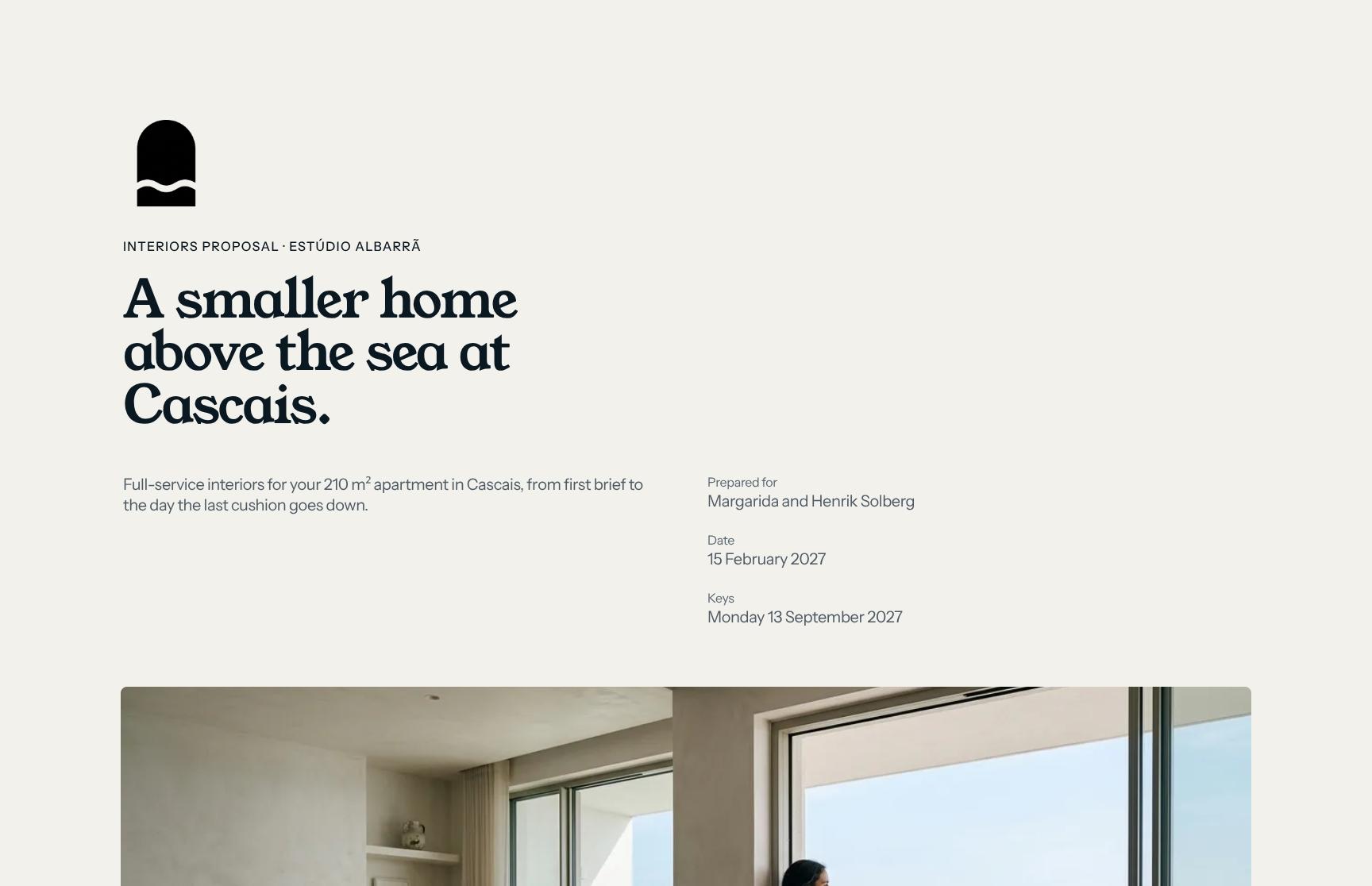
Here is a complete illustrative proposal for a fictional apartment refresh, with every line annotated so you can see which client objection it answers before the client raises it.
Illustrative example: a fictional client wants to refresh a three-room apartment (living room, bedroom and home office) for a calmer, warmer feel. They work from home, have a dog, and want the office to disappear behind closed doors in the evening.
The proposal opens with a summary of that brief in four sentences, then a visual direction board: 6 reference images labelled as reference, and 2 proposed concept boards labelled as concept. Scope is stated as 3 rooms, 2 concepts per room, 1 revised concept, 4 rendered views and 2 revision rounds. The timeline runs over 12 weeks, from weeks 1 to 4 for concept, weeks 5 to 9 for sourcing and weeks 10 to 12 for install and reveal.
Illustrative example: fee table for the apartment refresh
| Line | Amount | Why it exists |
|---|---|---|
| Concept and space plan | $3,200 | Answers "what am I paying for first?" with a fixed phase fee |
| Sourcing and procurement | $2,800 | Covers ordering, chasing and checking every delivery |
| Install and reveal | $2,000 | Shows the finish is part of the job, not an extra |
| Design fee total | $8,000 | The only number that is your fee |
| Furniture and decor budget (pass-through) | $25,000 | Kept apart so the fee is not mistaken for the full spend |
| Procurement handling fee | $2,500 | Named upfront so the markup is never a surprise |
Illustrative example: payment schedule and acceptance
| Milestone | Payment | Objection it answers |
|---|---|---|
| On signature | $2,400 | Reserves the studio's time and starts the concept phase |
| Sourcing starts | $3,200 | Paid only once the client has approved a concept |
| Install complete | $2,400 | Holds back the last payment until the room is finished |
| Proposal valid until | 30 days from the cover date | Gives a reason to decide without pressure |

What the annotations teach
The summary earns the read
Writing the brief back in the client's words proves you listened before you ask them to trust your taste.
Labels prevent false promises
Separating reference images from proposed concepts stops a client from expecting a room you never meant to design.
Counts end the scope argument
Rooms, concepts, views and rounds stated as numbers leave no room for a quiet extra option later.
Two kinds of money, two lines
The design fee and the furniture budget never share a total, so the fee reads at its real size.
The last payment waits for the reveal
Holding back the final milestone tells the client you are confident about finishing well.
Send
Send it as a trackable web proposal and follow up with evidence
Send the proposal as a link you can track, follow up while the conversation is still warm, and run a short pre-send check so the client never finds a mistake before you do.
The time between sending and hearing back is where good proposals go quiet. The client opens it on a phone, shares it with a partner, means to come back to it, and the week fills up. You cannot control their calendar, but you can control how quickly the next conversation is booked.
In The Most Surefire Way I've Found to Win Enterprise Deals, Chopra-McGowan told First Round Review that when traveling to meet a client, it works well to request a follow-up meeting within 24 hours of the first one, scheduling both at the same time upfront, sometimes even the same day.
Borrow the habit for interior work. Book the proposal walkthrough at the end of the consultation, before you leave the client's home, and send the proposal ahead of that meeting. The walkthrough becomes the follow-up, and the client arrives with questions instead of silence.
When traveling to meet a client, we've found it works great to request a follow-up meeting within 24 hours of the first one (schedule both at the same time upfront), sometimes even the same day.
This is where Formlio fits. A PDF goes into a black box. A Formlio document reports back: who opened it, what they read, when they signed. For an interior studio that means seeing whether the client lingered on the direction board, skipped the fee table, or came back to the payment schedule twice before the walkthrough. You follow up on what they actually read, not on a guess.
The proposal itself is built from blocks: a gallery for the moodboard, a timeline for the phases, an interactive pricing block for the fee, and an agreement block with slide-to-approve or e-signature right under the total. Once a proposal like this works, duplicate it for the next client and change only what is theirs. Shared through an open link, the same document doubles as a portfolio piece that shows prospects how you work.
Pre-send checklist
The summary uses their words
Reread the brief from your consultation notes and check the summary quotes the goals the client actually named.
Every image is labelled
Each picture on the direction board says reference or proposed concept, and products say confirmed or placeholder.
Scope is counted
Rooms, concepts, views and revision rounds are numbers, and the exclusions list is written down.
Fees and pass-through are apart
The design fee, the furniture budget and any procurement markup each sit on their own clearly named line.
Acceptance is one step
A validity date and a single approve or sign action sit directly below the total, with nothing to print.
The follow-up is booked
The walkthrough meeting is already in both calendars before the proposal link leaves your outbox.
Questions
Frequently asked questions
It should follow the client's decision order: a short project summary, the visual direction, scope stated in counts, a timeline with client inputs, fees kept apart from furniture costs, and a single clear acceptance step. In Formlio you can build that order from blocks and add an approval right under the fee.
There is no single official rule. The phrase usually refers to the markup or handling fee a designer adds when buying furniture at trade prices. Whatever rate you charge, name it on its own line in the proposal and say what it covers.
Yes. Tie the first payment to signature so it works as a retainer, then link later payments to phases such as the start of sourcing and the end of installation. It keeps you from designing on credit.
Long enough to answer the client's questions in order and short enough to read in a single sitting. Cut anything that does not help them decide: the moodboard and the fee table matter far more than a long studio history.
A proposal sells the approach: the look, the scope, the timeline and the fee. A contract fixes the legal terms. Many studios combine them by adding terms and an e-signature to the proposal, which Formlio supports with its agreement block.
A general chatbot can help you tidy wording or draft a checklist, but it cannot know your client's brief, your fees or your sourcing. The parts that win the job, the direction board and the counted scope, still come from you.
Book the walkthrough before you send, so the follow-up is already in the calendar. If you share the proposal as a Formlio link, you can see which sections the client read and open the conversation there.
Template
Build your next interior proposal with blocks
Start from a moodboard, add a counted scope and a clear fee table, and let the client approve right inside the document. Then see what they read after you hit send.